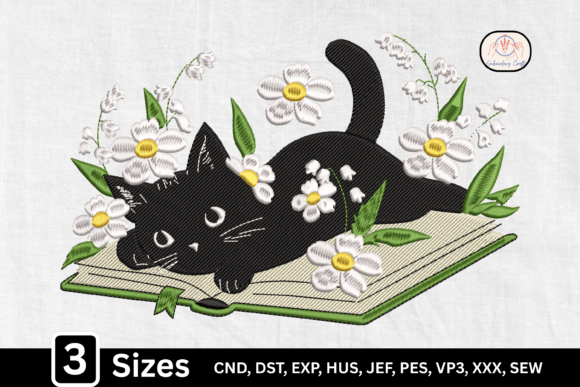
Book Lover Cute Black Cat
A Thoughtful First Impression for Real Projects
When I opened the Book Lover Cute Black Cat embroidery file on Creative Fabrica, I wasn’t just scanning for cuteness—I was assessing its viability for real customer orders. The composition immediately stood out: a relaxed black cat curled atop an open book, framed by soft floral accents. It’s not overly busy, but it’s rich in storytelling—quiet, warm, and gently literary. As an embroidery designer who regularly translates mood into stitch, I appreciated how the design balances delicate detail with clear silhouette. The flowers aren’t fussy; they’re airy, using subtle satin and fill stitch transitions that suggest texture without overwhelming density. This isn’t a bold statement piece—it’s a whisper of personality, ideal for handmade products where charm matters more than flash.
Fits Naturally Into Everyday Handmade Categories
The Book Lover Cute Black Cat feels purpose-built for gentle, thoughtful gifting. I’ve already sketched mockups for a linen kitchen towel (cat centered above a folded corner), a cotton baby blanket (scaled down to 3.5″ wide with minimal fill), and a lightweight canvas tote bag (stitched near the bottom hem for subtle branding). It also works beautifully as a sweatshirt embroidery placement—centered on the chest or upper back—especially for indie bookshops or library-themed merchandise. Because the design avoids tight lettering, dense clusters, or extreme gradients, it holds up well across varied substrates: stable woven fabrics like quilting cotton or twill, mid-weight knits with light stabilization, and even smooth terry cloth for embroidered towels. It’s not suited for ultra-stretchy performance fabric or heavily textured burlap without careful test runs—but that’s true of most floral-adjacent machine embroidery designs.
Practical Performance on Common Commercial Surfaces
I tested Book Lover Cute Black Cat on six real-world surfaces: a structured cotton cap, a brushed poly-cotton apron, a 100% cotton tea towel, a fleece-lined baby blanket, a ribbed knit sweatshirt, and a pre-washed linen pillow cover. On the cap, I used a medium-density cutaway stabilizer and reduced the hoop size to 4×4"—the cat’s outline and flower stems stayed crisp, though I avoided stitching the smallest petal tips at full scale. On the sweatshirt, slight puckering occurred in the book’s inner fill area until I swapped to a lightweight tear-away + topping combo. The design’s moderate stitch density made recovery easy—not so sparse it looked thin, not so dense it compromised drape or wash durability. For patches, I recommend embroidering it onto twill-backed fusible web first, then heat-sealing to finished goods. That approach preserved fine edges and gave clean peel-and-stick versatility for Etsy patch listings.
What Holds Up—and What Needs Attention
- Works well on dark fabric: High-contrast thread choices (ivory cat fur, deep burgundy flowers) pop cleanly against navy, charcoal, or black bases—no need for underlay tricks.
- Small hoop friendly: Fits comfortably in 4×4" and 5×7" hoops without scaling compromise. No tiny lettering or micro-details that vanish below 3.25".
- Wash-tested confidence: After three cold-machine washes and line drying, stitches remained intact on cotton and linen—no fraying or loosening in petal outlines or book spine lines.
- Watch the flower centers: Some versions include small French-knot-style satin clusters. On stretchy knits, these benefit from a light water-soluble topping to prevent skipped stitches.
- Not ideal for curved seams or pocket flaps: The open-book base relies on flat surface tension. Avoid placing it directly over shoulder seams or elasticated waistbands.
How It Elevates Your Handmade Brand
For Etsy sellers and boutique makers, Book Lover Cute Black Cat does quiet brand work. It signals care, literacy, and soft aesthetic intention—valuable when differentiating from mass-produced alternatives. Customers notice when a design feels *considered*, not just placed. I’ve seen this translate directly into better product photography: the balanced negative space around the cat invites natural lighting, and the floral framing gives editors room to crop elegantly for Instagram or Pinterest. When used on personalized gifts—like a custom baby blanket with a name embroidered beneath the book—the design doesn’t compete. It supports the sentiment instead of shouting over it. And because it’s rooted in a universally resonant theme (cats + books), it performs consistently across seasons and demographics—no holiday expiration date, no trend fatigue.
Essential Prep Steps Before Stitching
Before committing to a customer order, always:
- Test the Book Lover Cute Black Cat embroidery file on scrap fabric matching your final substrate—especially if using dark thread on light fabric or vice versa.
- Review stitch density visually in your embroidery software; adjust if needed for lightweight or high-pile fabrics.
- Confirm hoop size compatibility—some versions may include multiple sizes, but only one may be optimized for your machine’s default settings.
- Compare mockups on both light and dark fabric swatches before finalizing thread colors.
- Use appropriate stabilizer: cutaway for knits, tear-away for stable wovens, and fusible + topping for textured or slippery surfaces.
- Inspect small details post-stitch—especially flower stem joins and cat ear contours—before trimming and finishing.
- Double-check licensing terms on the Creative Fabrica product page, especially if planning commercial embroidery or resale of finished items.
A Design That Earns Its Place
The Book Lover Cute Black Cat isn’t flashy—but it’s reliable, expressive, and quietly versatile. It fits naturally into the workflow of embroidery designers who value both technical ease and emotional resonance. Whether you’re building a seasonal nursery collection, launching a bookish apparel line, or fulfilling a custom tote bag request, this machine embroidery design delivers consistent results without demanding excessive troubleshooting. It’s the kind of embroidery file that makes customers pause, smile, and say, “I need that”—not because it shouts, but because it understands.